Type "help with VA claim" into a search bar and you'll meet an industry: claims companies, coaching outfits, consultants charging $1,000 or more to "prepare" a claim they aren't accredited to file, can't represent you on, and won't stand behind when the VA gets it wrong. So before anything else, learn the rule that industry hopes you never read: federal law bars accredited attorneys and agents from charging fees for work on an initial claim before the VA decides it. Anyone charging you up front to prepare a first claim is working around that rule, not under it.
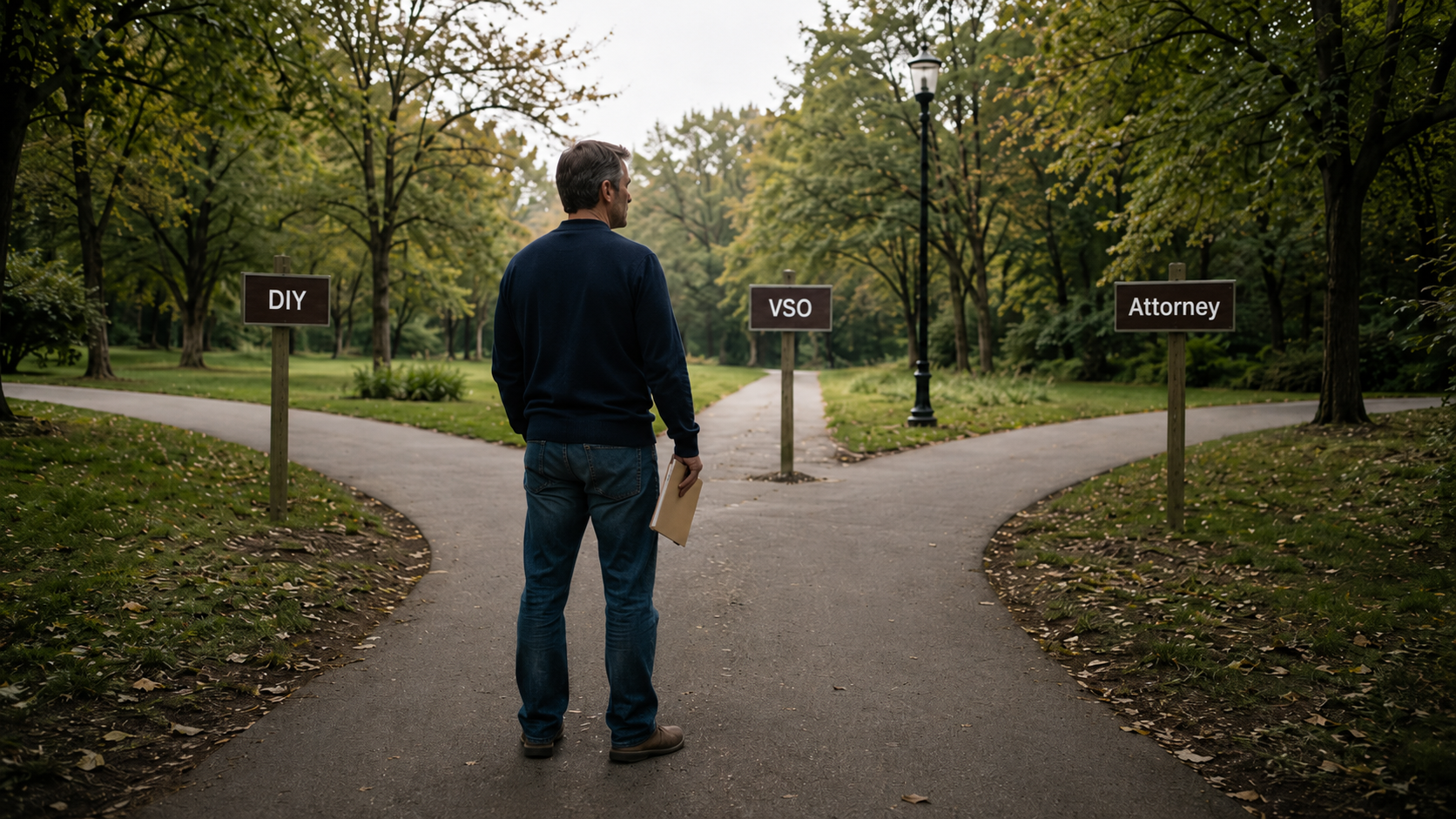
Here's the part that surprises people. That law doesn't mean you can't have a lawyer for your first claim. It means that when you do, the initial claim costs you nothing. Which reshapes the real question: for a first claim, your three honest lanes are doing it yourself, using a Veterans Service Organization, or having accredited attorneys represent you at no charge. Here's the straight version of each.
Lane one: doing it yourself
Filing your own claim is completely legitimate, and for a straightforward, well-documented claim it works fine. The application isn't the hard part; VA.gov walks you through it. What decides DIY success is everything around the form: knowing the three elements the VA grades, having your
records gathered before you file, and walking into the
C&P exam understanding what's being scored. Do that homework and DIY costs nothing and keeps you in full control.
Where DIY strains is where files get complicated: multiple conditions, conditions connected to each other, thin or silent service records, exposure histories, mental health claims where telling the story is itself the hard part. Not because the form gets harder. Because the file does.
Lane two: Veterans Service Organizations
VSOs, outfits like the DAV, VFW, American Legion, and your county and state veterans service offices, help veterans prepare and file at no charge, ever. That's their mission, and for straightforward claims a good accredited service officer is a genuinely good answer: they know the forms cold, they spot conditions you forgot to count, and they keep the process from becoming your second job.
The honest limits: quality varies office to office, caseloads run heavy, and a service officer's job is to file your claim competently, not to build legal strategy around a complicated one. For a clean single-condition claim, that tradeoff barely matters. For a file with real complexity, it can be the difference between a grant and a fixable-but-painful denial. Using a VSO doesn't lock you in; you can change representation at any point.
Lane three: attorney representation, at no charge
This is the lane most veterans don't know exists, because for years it barely did. Accredited attorneys can fully represent you on an initial claim; the law just says they can't charge you for it until after the VA's decision. Most firms responded by not touching initial claims at all. We built our practice the other way:
Valor First Claim is full representation on your initial claim by accredited veteran attorneys, at no charge. Zero fee, in writing, from intake through the VA's decision.
What that looks like in practice: a full review of your service and medical records, a written roadmap of what's being claimed and why, your statements developed with guidance instead of guesswork, preparation before any C&P exam, and a filing built as complete as the evidence allows. Because the representation is on file with the VA, the decision comes to your lawyers the same day it comes to you, and gets read against the record they built.
The honest limits here too: slots are limited, and the program prioritizes the claims where lawyering actually earns its keep, multiple or connected conditions, exposure histories, undocumented in-service events, conditions that keep you from working. If your claim is a clean single condition with tidy records, we'll tell you a VSO serves you well and point you to one. And no lawyer, ours included, controls the VA's timeline or can promise you a rating; walk away from anyone who does.
The decision tree, honestly
Strip it down. Straightforward claim, willing to do the homework: DIY works and costs nothing. Straightforward claim, want experienced hands: an accredited VSO, also nothing. Complex claim, connected conditions, gaps in the record, or high stakes if it goes wrong: attorney representation exists for exactly that, and for the initial claim it also costs nothing. The only lane with a price tag is the unaccredited claims-company lane, and it's the one lane that can't file for you, can't represent you, and disappears when the decision goes sideways. Don't fund it.
Whichever lane you pick, remember what actually decides the outcome: the file. Representation is a multiplier on a well-built claim, not a substitute for one.
Where we come in
We're a veteran-led firm, and we now work both ends of this fight:
free initial claim representation when the record is being made, and
appeals when the VA gets a decision wrong. The initial claim is where the record gets built, and we'd rather build it correctly as your lawyers, for free, than profit from cleaning it up later. If your first claim has real complexity, or you just want a straight answer about which lane fits,
reach out and you'll get one, including "a VSO is all you need" when that's the truth.