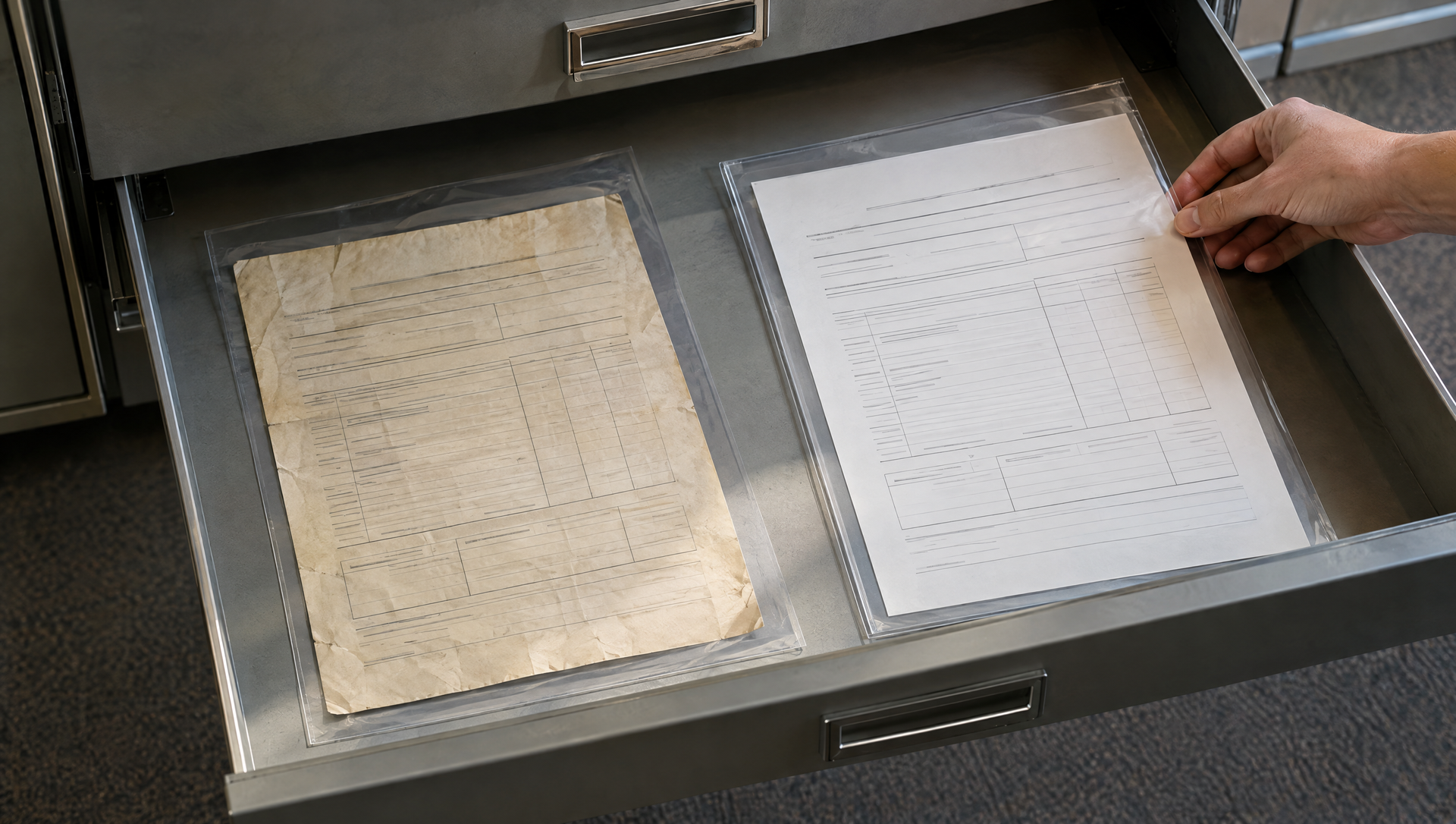
Here's an uncomfortable truth about your first claim: the VA has a legal duty to help gather your records, and you should behave as if it doesn't. Records requests get missed, archives return partial files, private providers ignore faxes, and the claim gets decided on whatever made it in by decision day. The veterans who do well on first claims are, overwhelmingly, the ones who showed up holding their own paper.
So before you file, or right alongside it, run this records mission. Every document below either proves an element of your claim or protects your credibility. None of them are optional if they exist.
Your DD-214: the skeleton key
Start here, because nearly everything else keys off it. Your DD-214 establishes when and where you served, your specialty, your decorations, and your discharge, the facts that determine everything from basic eligibility to presumptive-lane coverage. If you can't lay hands on yours, request it through the National Archives or the DoD's online portal; it's free, and turnaround is usually reasonable for recent-era service. Order it first because other requests will ask for it.
Service treatment records: what happened while you were in
Your service treatment records (STRs) are the medical file the military kept on you: sick call visits, injuries, profiles, medications, your separation exam. For the in-service element of your claim, this is the primary source, and its gaps matter as much as its contents. Get the whole file, read it, and note two things: everything that supports your claim, and everything you remember that isn't in there. The second list tells you where you'll need
witness statements to fill the silence. Where the file lives depends on your era and branch; recent-era records are typically retrievable through the same federal records channels as the DD-214, and older files sit with the National Archives. Request early: this is routinely the slowest document in the stack.
For certain events, don't stop at medical records. Personnel files, performance evaluations, unit records, and line-of-duty determinations can corroborate an incident, a deployment location, or a decline in performance that tracks a condition's onset, and for events that were never medically documented at all, they're sometimes the only official paper that anything happened.
Post-service medical records: proving the "now"
The current-diagnosis element runs on your civilian and VA treatment history. Two streams to pull. VA medical records, if you treat at the VA, are yours to download through the VA's online patient portal or to request in full from your facility's records office; get the complete file, not the summary. Private records need to come from each provider, and here you have a choice: gather them yourself, which gives you control and a copy of your own, or authorize the VA to request them for you using its medical-release form. Do both when in doubt: sign the release so nothing is technically missing, and pull the critical records yourself anyway, because a claim shouldn't hinge on whether a clinic answered a fax.
If a condition hasn't been treated recently, get seen before or as you file. A diagnosis from years ago with no current treatment invites the VA to question whether the disability still exists, and a fresh evaluation closes that door.
Your own statement: the record only you can write
One document won't come from any archive: your personal statement. Written on the VA's statement form or as a plain declaration, it's where you connect the file's dots in your own words: what happened, when symptoms started, how they've continued, and what they cost you day to day. Specific beats dramatic; dates, places, and concrete examples out-punch adjectives every time. Pair it with statements from spouses, buddies, or supervisors who watched the arc, and the "silent gaps" in your official records start speaking.
A pile isn't a file. Before filing, sort what you've gathered by condition, and within each condition by element: here's the diagnosis, here's the in-service event, here's what connects them (the framework we've broken down in
the three-element test). Duplicate nothing, hide nothing, and keep a complete copy of everything you submit; your own records file will matter again at the
C&P exam, and again if the decision needs fighting. If you're not ready to file while the gathering runs, an Intent to File protects your date in the meantime; we've covered how that works and why it's worth money.
What this buys you
A records-first claim does three things a hope-first claim can't. It files complete, which is the single biggest lever on speed and on getting it right the first time. It front-loads your credibility: a veteran who hands over an organized file reads differently than one whose claim is a form and a prayer. And it means that if the VA still gets it wrong, the
appeal starts from a built record instead of from scratch.
And if the gathering itself is the wall, records scattered across eras, providers, and archives, that's one of the exact problems our
Valor First Claim program exists to solve: full attorney representation on your initial claim, at no charge, including the records work. However you file, if the decision comes back wrong,
reach out
and bring that file; you'll be glad you built it.