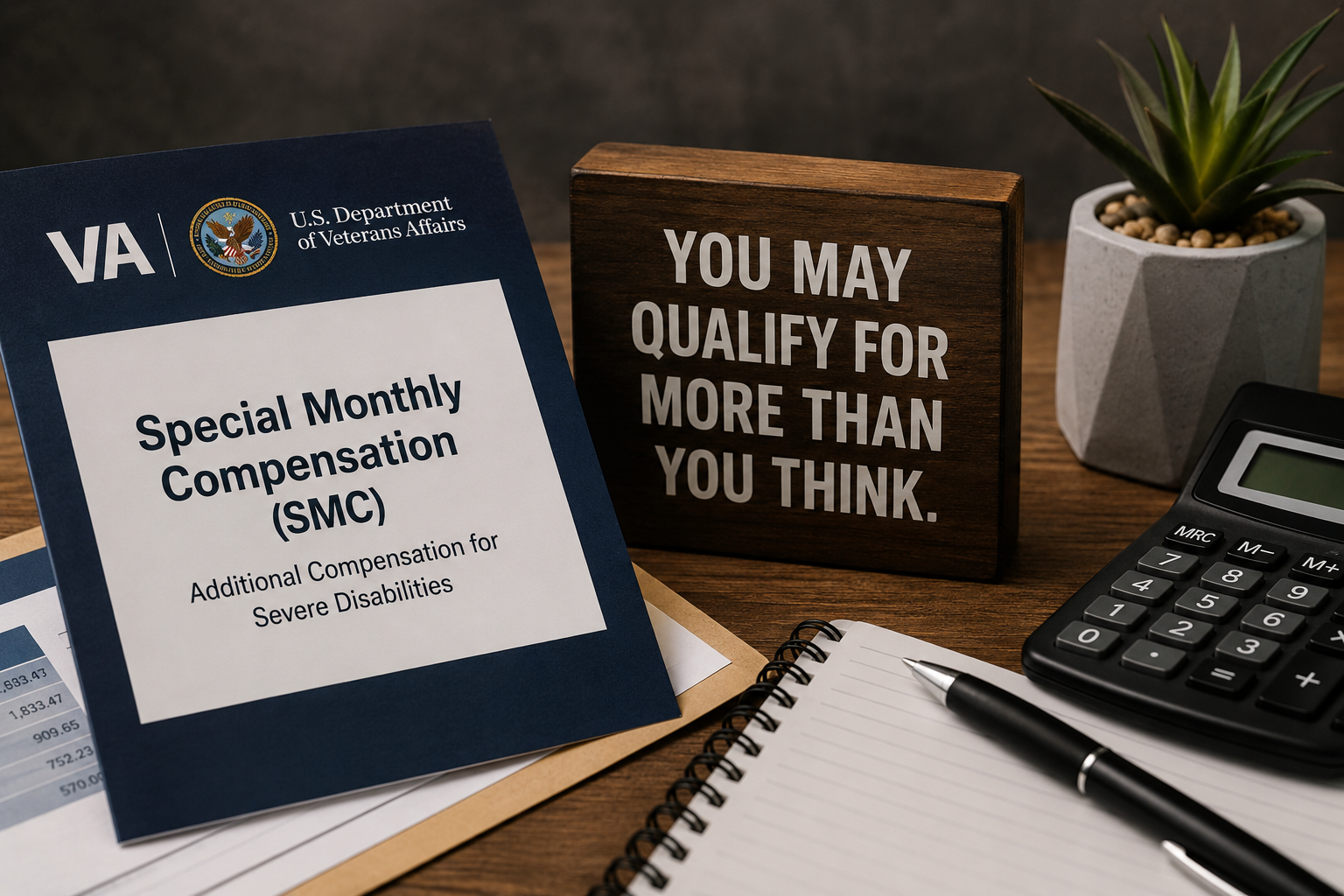
Most veterans have never heard of Special Monthly Compensation. The ones who have usually heard the term in passing, assumed it was for somebody worse off than them, and moved on.
That's a mistake.
SMC is one of the most under-claimed benefits in the entire VA system. It pays on top of your regular disability compensation. It can add hundreds — sometimes thousands — of dollars to your monthly check. And the VA, in its infinite generosity, is not required to bring it up. If you don't ask, you don't get it.
Here's what it is, who qualifies, and why so many veterans who should be getting SMC aren't.
What SMC Actually Is
Special Monthly Compensation is extra money the VA pays for specific situations that go beyond what the standard rating schedule covers. The regular rating schedule is built around percentages — 30 percent for this, 50 percent for that, combined using the VA's famously bizarre math.
But the schedule has blind spots. It doesn't fully account for losing a hand. It doesn't capture what it means to be housebound. It doesn't cover the cost of needing another person to help you bathe or eat or get dressed. SMC fills those gaps.
SMC is paid in addition to your regular compensation, not instead of it. A veteran rated at 100 percent schedular who also qualifies for SMC gets the 100 percent rate plus the SMC rate on top. It's not a replacement. It's a stack.
The SMC Levels (And Yes, There Are a Lot)
SMC comes in levels lettered roughly A through T, with subcategories sprinkled in. Don't get lost in the alphabet. Here are the ones that matter most for the largest number of veterans:
- SMC-K — Paid for the loss, or loss of use, of a specific body part. This includes a hand, a foot, an eye, reproductive organs, or one or both breasts (yes, the regulation says that). SMC-K is a flat additional payment per month on top of your regular comp, and you can stack multiple SMC-K awards if you qualify for more than one.
- SMC-L — Paid when you need the regular aid and attendance of another person to handle basic daily activities. We're talking bathing, dressing, eating, using the bathroom, protecting yourself from everyday hazards. Also paid for being permanently bedridden or for loss of use of both feet, both hands, blindness in both eyes, or similar combinations.
- SMC-M, N, O, P — Higher levels for more severe combinations of loss or loss of use. The categories get more specific as you climb. SMC-O, for instance, covers things like total blindness combined with loss of use of both legs.
- SMC-R1 and R2 — The highest non-special levels. These apply when a veteran needs aid and attendance and has additional severe disabilities on top. R2 specifically requires a higher level of care, like care that's the equivalent of skilled nursing.
- SMC-S — This is the one most veterans miss. SMC-S is paid when you have a single disability rated at 100 percent and either (1) additional service-connected disabilities rated at 60 percent or more, OR (2) you're permanently housebound due to your service-connected conditions. This is the "housebound" rate, and it's quietly available to a lot of veterans who never get told about it.
- SMC-T — Created specifically for veterans with traumatic brain injuries who need aid and attendance and would otherwise require hospitalization or institutional care. TBI-specific. Often missed.
Why SMC-S Is the One to Pay Attention To
If you take one thing from this post, take this: SMC-S is the level that gets overlooked most often, and it's the one that applies to the most veterans.
Here's the rule, in plain English:
If you have one service-connected disability rated at 100 percent, AND you have other service-connected disabilities that combine to at least 60 percent (separate from the 100 percent one), you qualify for SMC-S. You don't have to be housebound. You don't have to need aid and attendance. You just have to have the ratings.
That's it. That's the whole test.
A veteran rated 100 percent for PTSD, with a 40 percent rating for a back condition, a 20 percent rating for tinnitus, and a 10 percent rating for a knee — those secondary conditions combine to 60 percent or more under VA math. That veteran qualifies for SMC-S and might not know it.
The alternative path to SMC-S is being permanently housebound — meaning your service-connected conditions confine you to your house or immediate premises, and that confinement is reasonably certain to continue for the rest of your life. This is a higher bar and requires medical evidence.
But the "100 plus 60" path? It's just math. If you qualify on paper, you qualify.
Why So Many Veterans Miss This
A few reasons. None of them are good.
- The VA isn't required to bring it up. When a rater grants you 100 percent, they're not obligated to evaluate you for SMC unless there's something in the file that flags it. Some raters do it anyway. Most don't. If your decision letter doesn't mention SMC, that doesn't mean you don't qualify. It usually just means nobody looked.
- The regulation is dense.
38 CFR 3.350 and its companion sections lay out the SMC criteria in a way that's hard to parse even for people who do this for a living. Most veterans reading their own rating decision aren't going to cross-reference it against the SMC regulations.
- Aid and attendance has a reputation. A lot of veterans assume "aid and attendance" means you need a full-time caregiver. It doesn't. The legal standard is whether you need the regular assistance of another person for basic daily activities — not constant, not 24/7. Someone helping you get dressed in the morning and bathe a few times a week can be enough.
- The application process is its own thing. SMC isn't always automatic even when you qualify. Sometimes you have to file for it specifically, often on a
VA Form 21-2680 (Examination for Housebound Status or Permanent Need for Regular Aid and Attendance) or by submitting evidence and arguing the issue directly to the VA.
How SMC Plays With TDIU
This is where it gets interesting, and where a lot of veterans (and frankly, a lot of VSOs) get confused.
TDIU — Total Disability based on Individual Unemployability — pays a veteran at the 100 percent rate when their service-connected conditions prevent substantially gainful employment, even if the schedular rating is less than 100 percent. For SMC-S purposes, a TDIU award based on a single disability can count as the "100 percent rating" required by the housebound statute. If you have TDIU based on one disability and you also have other service-connected conditions combining to 60 percent or more, you may qualify for SMC-S.
The Federal Circuit and the Court of Appeals for Veterans Claims have litigated this issue extensively, and the rules have shifted over the years. The current framework allows SMC-S in many TDIU situations, but the analysis depends on whether the TDIU is based on a single disability or a combination of disabilities. If it's based on a combination, the path is harder.
Translation: if you're on TDIU and have other ratings stacking up next to it, you should be looking at SMC-S. The math isn't obvious. But the money is real.
What SMC Is Worth
The actual dollar amounts change every year with the cost-of-living adjustment, so any specific number here will be out of date within months. The VA publishes current SMC rates on its compensation page, and they're broken out by level and dependency status.
For a rough sense of scale: SMC-K runs around $130 a month at recent rates. SMC-S adds several hundred dollars a month above the standard 100 percent rate. SMC-L through R are larger, sometimes much larger — R2 is well above standard 100 percent comp on its own.
Over a lifetime, the difference is significant. A veteran who qualifies for SMC-S at age 55 and lives to 80 is looking at six figures of additional compensation they would not have received without filing for it. SMC isn't pocket change.
What to Do If You Think You Qualify
The honest answer depends on where you are in the process.
- If you've never been evaluated for SMC and you have a 100 percent rating: Pull out your rating decision. Look at the individual ratings that make up your overall picture. Do you have one condition rated at 100 percent plus other service-connected conditions adding up to 60 percent or more? If yes, you're a strong SMC-S candidate. File for it.
- If you need aid and attendance for daily activities: Get a statement from your doctor describing the assistance you need. The VA has a specific form for this (21-2680), but a thorough medical statement that addresses the legal criteria can be more useful than a checkbox form filled out in five minutes.
- If you have a TBI: SMC-T exists specifically for you. It's underutilized. If your TBI is significant enough that you'd otherwise need institutional care, this is the level to look at.
- If you've been denied SMC before: SMC denials get appealed all the time, and they get reversed all the time. The reasoning in SMC denials is often thin, and the underlying medical and legal analysis is often wrong. If a denial doesn't seem to engage with the actual criteria — or doesn't engage at all — that's grounds for appeal.
The Bottom Line
SMC exists because Congress decided the regular rating schedule wasn't enough to compensate for certain combinations of severe disability. It's not a bonus. It's not a gift. It's something you earned, and the VA is required to pay it when you qualify.
But the VA isn't going to track you down to give it to you. You have to ask. And the asking has to be done right — with the right evidence, citing the right regulations, framed in a way the rater can't ignore.
If you're rated 100 percent and SMC has never come up, or if you've been denied SMC and the reasoning didn't sit right,
we can take a look. It's the kind of issue where a careful review of your file can quietly add a lot to your monthly compensation — and most of the time, no one else has bothered to do that review for you.